AI Implementation for Small Business, Without the Overwhelm
Business owners tend to start out brilliant at one thing. Building websites, fixing IT problems, running the numbers - whatever the trade is. You quickly realise that you also become a salesperson, recruiter, bookkeeper, marketer, and now, on top of all that, you need to get to grips with AI.
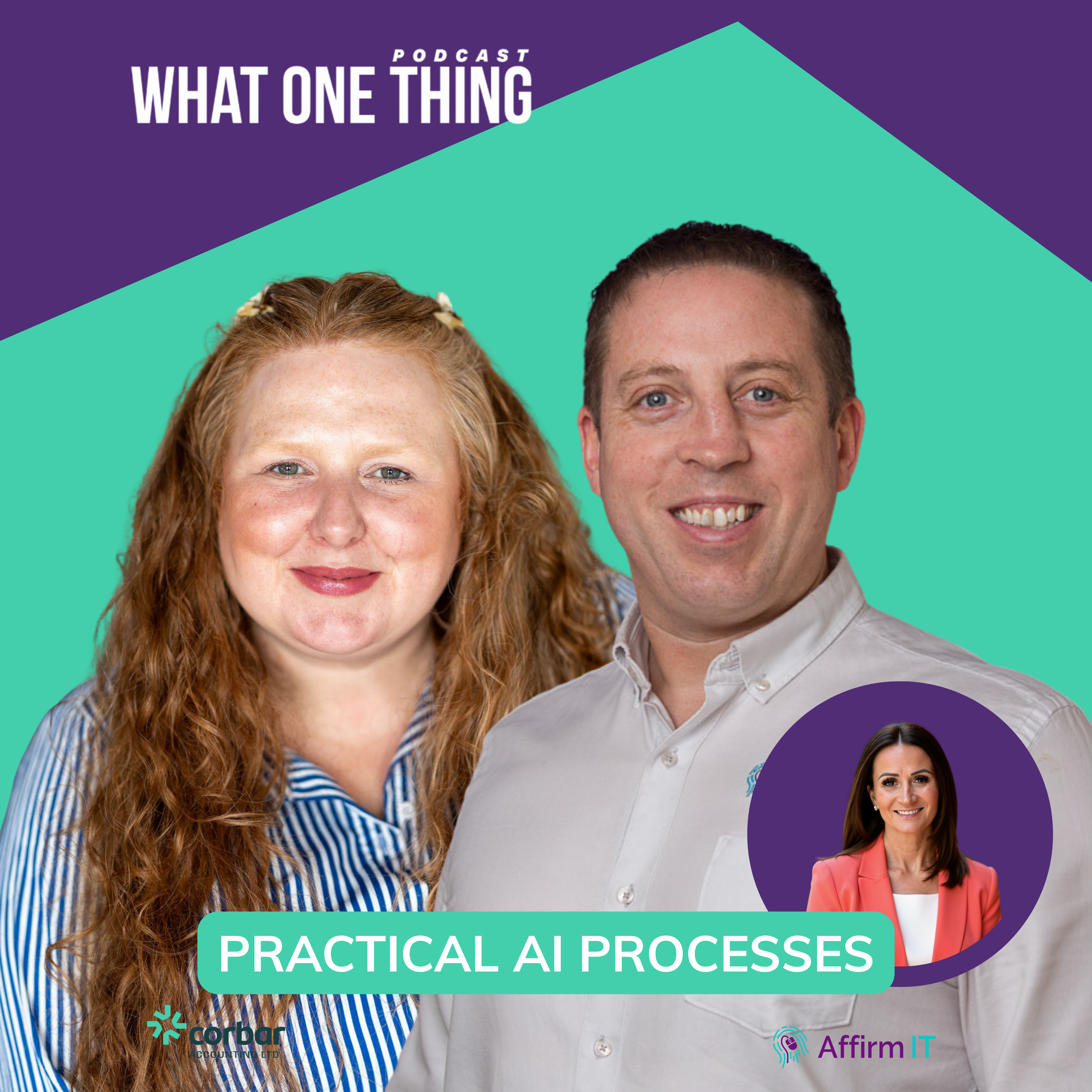
Marie Piercy joined us on the latest episode of What One Thing, and her one thing is using AI, mainly Claude, to take over the repetitive parts of her sales process so she's not the person doing every step herself. Here's what came out of the conversation.
1. You're probably the bottleneck in your own business
Founder-led businesses tend to follow the same pattern. Every step of the sales process runs through the founder. Research, outreach, follow-up, scheduling, proposals. It works fine initially and at a small scale, but becomes exhausting and unsustainable the moment you try to grow. Marie's seen this pattern in her own business and in every client she's worked with since.
Where to start: write down your sales process step by step. Put your own name next to every step you personally do. If your name appears more than three or four times, that's your answer.
2. Map the process before you touch a single tool
Before Marie brought AI into anything, she mapped out her entire sales process and examined each step critically. Which parts need her judgement and her relationship with the client, and which are repetitive tasks that eat time without needing a human at all.
Where to start: next to each step on your process map, write "needs me" or "doesn't need me." Be honest, and you’ll probably find fewer steps need you than you think.
2. Solve one task, not the whole system
Marie didn't build her entire AI-powered sales process in a day. She started with one painful task - the manual research that used to take her half an hour per lead - and solved that first. Everything else came later, one task at a time.
Where to start: Identify the single task in your business that takes the longest for the least reward. Find the best tool to speed it up, get results and then move on to the next one.
4. Keep the human where the human matters
Marie is clear that people still buy people. Research, CRM entry, nurture sequences, scheduling, even first-draft proposals, all handed to AI. The meeting and the relationship built in it remain entirely hers. The goal isn't to remove people from the whole process; it's to remove people from the boring, time-consuming or repetitive bits.
Where to start: Notice the parts in your process where the relationship is doing the real work. Protect those and automate around them.
5. Train your AI like you'd train a new employee
Marie made it clear that AI is only as good as the information you give it. Chuck a single vague prompt at it and you'll get a single vague result, and everyone ends up sounding the same. Give it a proper induction: your business plan, your marketing materials, your website, your tone, and it starts working more like a member of the team.
Where to start: pick one AI tool and spend some time feeding it context about your business before you ask it to do anything else.
6. Use AI to find more ideal clients
This was the standout tip of the episode. Rather than describing your ideal client from scratch (the sort of profile most businesses have written once and never looked at again), Marie feeds Claude an actual existing client she loves working with and asks it to find more businesses like that one. It changes the entire quality of the research.
Where to start: pick your best current client. Write up a short profile of them, industry, size, what makes them a joy to work with, and use that as the brief instead of an abstract ICP.
7. You don't have to build it yourself
Setting this up well takes time, and for busy business owners with skills in other areas, there’s zero appetite to spend a day learning a new tool from scratch. Marie suggested that if it's not your thing, bringing in someone to set it up for you isn't a shortcut you should feel bad about. It's a sensible use of your time.
Where to start: decide whether this is a project you want to learn yourself or one you'd rather hand to someone else. Either way is perfectly ok; you just need to make the decision rather than letting it sit on the to-do list.
Hayley's already testing lesson five on herself. She's handing this transcript straight to a colleague and asking her to have a go at building the lookalike research process. Keep an eye out for the results of that experiment.
Have a listen to the full episode wherever you get your podcasts. Search What One Thing.
Brought to you by Corbar Accounting and Affirm IT Services Ltd.