We Tried a 30-Day Business Challenge… did we win or learn?
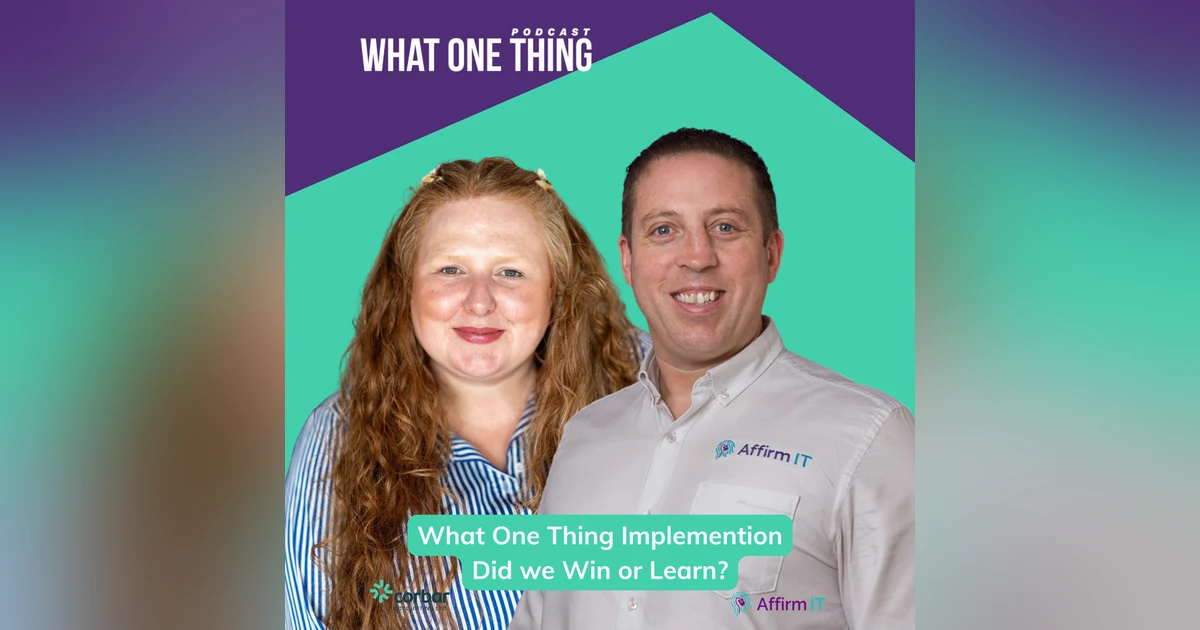



Phil Davenport and Hayley Baxter reflect on their attempt to implement a 30-day relationship-building challenge inspired by their own podcast advice.
What started with good intentions — outreach messages, networking coffees, introductions, and accountability — slowly became overwhelming as real business life got in the way.
In this honest conversation, they unpack:
- why consistency is harder than motivation
- the pressure business owners put on themselves
- relationship-building in growing businesses
- accountability vs competitiveness
- and why slower, more sustainable habits often work better long term
A thoughtful episode for business owners trying to balance growth, networking, marketing, and actually running the business at the same time.
🎙️ Brought to you by Corbar Accounting and Affirm IT Services Ltd.
Phil Davenport: Hang on, should we start again? If this is terrible, then we'll just reuse the recording of me introducing it first time around.
Hayley Baxter: No, no, won't be terrible, it'll be good.
Phil Davenport: Hayley before we get into how it went, I think the first thing we should do is just a quick recap on what we actually committed to last time round and why we picked relationships as our what one thing.
Hayley Baxter: So what we committed to was every week for around 30 days, so about a month, we were going to do five meaningful outreach messages. So this is reaching out intentionally to people the purpose of strengthening relationships, not selling to them. The second thing we were going to do was to commit to having one coffee or zoom conversation each week with someone in our networks and again it was all about being relationship focused. The third thing was to try to do an introduction between two people each week and the last thing was a following up or one follow up with somebody that we already know. Those were the four things that we committed to doing weekly.
Phil Davenport: Okay and I remember we committed to this because we've seen and heard other people talk about building relationships, how networking works and how reaching out to people and building deeper relationships really helped them out in their business. So tell me Hayley, how did it go for you? If you succeeded, what was the big win? and if you were less successful, when did it start to fall apart for you?
Hayley Baxter: So, I think it's a tale of two halves. The first half of the tale is, for the first two weeks... I think I did do it, I was on it, I was committed to it. We were keeping each other accountable, more or less, in that first two weeks. it was good because it was easier because it was new â you had lots of people that you could revisit or reconnect with or think, well, I haven't spoken to them for a while. So it kind of had a little bit of momentum behind it. The second half of the tailors, I think as we got into the second two weeks, life probably got a little bit busier for me it was harder to find the people who to connect with because I'd kind of used up my tokens if you like or obvious ones, low hanging fruit, whatever you want to call it. And then I think the accountability dropped â both sides, I think it's fair to say. somebody may or may not have had a holiday then I think and then I think it just it just kind of tinkered off into nothing is probably how â I would it but what I think is really interesting is from those first two weeks and some of the conversations and catch-ups I did have and people I did speak to that has actually strengthened relationships and done So I think the intention of the task was to build relationships and strengthen relationships with existing networks and to try to grow relationships with new people. And I do think that although I didn't stick to it for the whole 30 days, I do think that I did. I do think that the outcomes have been positive regardless of that. What's your thinking on how it all went and what went well for you? and what would you do differently if you did it again?
Phil Davenport: I a lot like â Toby Carvery, â went in with eyes bigger than my belly on this one and thought I could really throw myself into it, start booking lots of meetings, lots of coffees, lots of appointments and â about week and a half started to get overwhelmed by the amount of meetings, coffees, etc. I booked in. it started to interfere with my day-to-day life because I had so many meetings and I was driving out for coffees and bear in mind I probably only went out for three or four coffees but the travel time there 30-40 minutes to go meet somebody halfway then an hour, hour and a half chat and then 30-40 minutes back started to become very not overwhelming but very very much time constraining and then on top of that you start to have a course the bounce back of calendars of you know I'm really sorry Phil can't make this one can we move it to and it happened to be probably at the same time as yourself Hayley but I think with small businesses we go through periods of kind of fast growth or where you've got lots of sales meetings you've got projects and things like that and then it will slow down and when it's slow you're trying to reach out and book these meetings but of course then the meetings are in two weeks and it happens to be really fast and you regret everything I think we definitely over egged the pudding. I think we set way too ambitious targets that actually we then hit for the first week, which then meant on the second week we'd started to get that rolling momentum, which meant we were even busier. And then I think by week three, I mean, I'm just looking at my accountability tracker. And there's a message from you, Hayley, just said, have you given up? This is not part of the deal. Full stop. We need to be accountable. Full stop. So I think I broke first on the accountability challenge. I think. It's probably struck with me. And I've really enjoyed trying to build those connections and those relations. And we were talking earlier about how I spoke with lovely people. We went out there for a sales meeting and they had some spare office and I was talking to another person. They needed a spare office and managed to link them together. And I think that side of me is something that I really enjoy because it's bringing value and helping people out. I think maybe one meter a month would have been more realistic, very much less jazzy for our accountability challenge.
Hayley Baxter: Yeah, I think agree with most of what you said. think when it becomes full-time job, doesn't it? When you're trying to say, you've already got a full-time job is â kind of â I summed up. â And I for me, I've never been like an accountability person because I'm always a bit like, I've always been a little bit of the mindset. If I'm gonna do something, I'm gonna do it whether somebody's holding, trying to hold me accountable or not, because I'll do it for myself, if you know what mean. And if I don't wanna do it, the fact that someone's there telling me or, you know, trying to G me up or whatever, isn't gonna make a lot of difference to me. However, I do think, I do think in this, I do think that accountability at first did help us, because I know that we had a couple of message exchanges early on where, Like I'd not done it one day and you were like, you know, giving me a bit of, you know, ribbing or whatever and vice versa. But actually that did, it did help because it made me think like, well, actually I'm just going to go, I am going to go and do it. So that was something new for me because I've never experienced that before. I've always just been like, well, whatever, I'll do it if I want to do it kind of situation. And then, yeah, when that totally went off and then I was busy, I was just like, well, I'm not, it's just gone now. I'm not doing it. What I do think though, in the predictions at the beginning, I talked about 80 % success and you laughed at me saying so I'm, my succession is actually failure because I'm not going to do it 100 % but actually that was probably more realistic, upset in the bar of what was achievable to be truthful. And I think the real thing from what you've just said or the real challenge, and I don't know the answer to this, but the reality is that building relationships is key to growing your business and key to having a successful business. you do get busy and have peaks and troughs where you've got more time and less time. And I do think there is something about trying to keep that momentum going through the times when you are busy, rather than just letting it tail off to nothing and how you build that into the day to day of. running the business, not just being when you're quiet, you do those things, but actually building the momentum all the time. It's like the marketing piece, isn't it? When you haven't got any clients coming in or no new leads or you've lost clients, you do loads and loads of marketing to try and build your pipeline. Then things start coming in and then you get busy. So the marketing tails off and then you just go through that. It's like how you get how and it's the same principle of how you keep it going, but manage it within everything else.
Phil Davenport: I was talking to somebody yesterday and I was saying to you, he declined to come on the pod because he was a bit of a shrinking violet. But he talked about when you first open the business, you've got to wear all the hats. And then the aim of the game for him is to remove one hat as many times or as quickly as he can do. And I think a lot of this is about us trying to remove the hats. So one thing that I have started is we've started, Alastair Fantastic, Cold Caller Off. And he's doing that outreach because I realized actually â I don't really want to wear that hat. So I think maybe some of what you were talking about there isn't so much the failure of ourselves, although I suppose it is, but it's more our failure to delegate those roles off and maybe have a PA or a VA or have a marketing person who says, I'm going to reach out and just say, hi, Haley would love to have a chat with you. Would you like to make it for a coffee? rather than have the pressure of you doing that. And then again, I know that you said that 80 % was more realistic, but I think our targets were just completely off. And so having somebody who'd maybe got a bit more calendar management or maybe played the game before and could have said, actually, you know what, I'm going to book you in one meeting a month for the next nine months. And that's what our goal is going to be.
Hayley Baxter: Yeah.
Phil Davenport: And I suppose that the last point I would say is, I think we're probably all the same as business owners in accountability, that one of the reasons that we end up owning our own business is because... we struggled to be held accountable by other people, but we're also probably mostly really competitive. So whilst you probably thought that we were holding each other accountable, we were probably actually having a race. And while we enjoyed having the race, we both enjoyed it, we kept going. And then when the fun of that new shiny object in the race died off, actually, you know what, we don't fancy running the triathlon. gonna quit at 3K. I think that's probably what happened to us here.
Hayley Baxter: Yes, yeah, I'd agree with that. I think if somebody listening wants to try this What One Thing Challenge, what would you suggest they change from what we did to help make it more achievable?
Phil Davenport: I think set much lower minimum targets. So I think one coffee a month is really pretty good. And look, if you are quiet and you're in that period where you're just scrambling to try and generate some leads by all means, you know, booking four, five, six, however many you fancy. Realize that a lot of them are just going to be conversations and maybe they'll turn into something or you'll get recommended or, you know, in 12 months, 15 months. So. I think as â a new business owner or somebody that's really not busy at the moment, great to book that many. But I think for somebody of our size of business where you've got employees, you've got a reasonable turnover, you've got orders coming in, probably one coffee a month and probably one LinkedIn outreach a week, maybe not even that, maybe two outreaches a month would have done us as opposed to our lofty ambitions. What would you say to somebody, Hayley?
Hayley Baxter: I would agree with you've said. think... doing the initial bit, like the initial messages isn't so bad, but then people reply and you've got to reply and you're like, you've got to keep the momentum going. So then by like week four, you're having like 15 or 20 conversations, which does then become overwhelming to keep up with that. Or I found that, I found that anyway. So I think, I think also the thing with the challenge is perhaps a little bit. Did we always reach out to people who were... the best people to build relationships with to help us grow our business or where we just reaching out to people to tick the box. That's something as well thought about in that first couple of weeks. So I think it's just about keeping it realistic for you â not... we would have been better doing less and keeping the consistency going and building it into a habit that we're still doing today than trying to go all in at it. like now we just don't, I'm not, well, we're doing it in a roundabout way, but not really doing it in a way, I suppose, which again was part of what we talked about doing. So I think for me it's just about being aware of that and then again just trying really hard to think about keeping the consistency over the longer term than just hitting it in a high go. If we do this What One Thing implementation again for another What One Thing, which we have talked about doing, because we've got loads of great advice in all of our podcast episodes, do you have anything that you think we should do differently to try and make sure that we stick to it for 30 days? It's not that hard to do something for 30 days.
Phil Davenport: In the world of boxing, we either win or we learn. In this case, I think that we've learned that you don't implement these ideas over 30 days, that these aren't sprints, that we went to the gym hoping to get a six pack in 30 days, and we ended up laying on the sofa unable to get up because the pain in our abs was too high. I think we can do one of a couple of ideas so we could try and implement, I shouldn't use the word try, we could implement a couple of what one things over a three month period and go much slower, much more gradual. And I know that's more boring, but maybe that is actually the business lesson that we could all learn is that slow consistency beats rapid growth and then failure over time. So perhaps we'd choose a couple of what one things to implement. we implement much more steadily over three months. because â a very gracious winner, not a fan of failure, maybe â this what â one those what one things that we implement in a steady period. What do you think, Hayley?
Hayley Baxter: I like that, I like the doing it over a longer period because ultimately all of these things that we're trying to do to help make our businesses better need to be embedded and to be able to be done consistently over a longer time period. So I really like that idea relationships â the foundation of business, whatever way you dress it up. So I'm very on board with this being part of. that three month challenge. So I think it's probably a good point to wrap there. We hope you found one thing to help move your business forward and we hope that you join us next time when we might be talking about the What One Thing three month implementation programme.
Phil Davenport: Yep, we either win or we learn. Thank you very much for listening. If you did enjoy this and you found something useful to take away, then please recommend this podcast to your friends. I'm Phil Davenport from Affirm IT.
Hayley Baxter: I'm Hayley Baxter from Corbar Accounting